
Discovering Bukhara: A Timeless City on the Silk Road
- Kayıhan Badalıoğlu
- 16 May 2025
- 12 dakikada okunur

Located in Uzbekistan, Bukhara is one of Central Asia’s most historically significant cities. With a history stretching back over 2,500 years, Bukhara played a key role along the Silk Road for centuries. Today, the city is home to numerous UNESCO World Heritage Sites and is renowned for its traditional bazaars and vibrant local culture. In this post, I’ll be sharing my personal experiences and observations from my journey to Bukhara, along with practical tips for future travelers.
If you're planning to visit Bukhara, this post might be the perfect first step. From ancient architecture to local customs, I hope my notes will serve as a helpful guide for your travel plans. Wishing you a wonderful journey!
Arrival & Transportation: First Impressions from the Airport
I landed at Bukhara International Airport early in the morning, only to face my first surprise: there was no public transportation in sight. The only option to reach the city center was by taxi.
The Taxi Reality: While the Yandex Taxi app usually offers affordable rides (around $2–3), it doesn’t always work reliably without a local SIM card. In such cases, negotiating with local drivers becomes essential. If you don’t settle on a price beforehand, you might be charged unexpectedly high fares — even for short distances (e.g., $5 or more). Always confirm the fare before you get in!
Accommodation: Booking Pitfalls & Local Hospitality
Despite booking my hotel through Booking.com, the reservation was shown as canceled when I arrived. Luckily, the hotel staff kindly redirected me to a nearby guesthouse.
A Word of Caution: These types of booking issues are not uncommon at smaller hotels in Bukhara. To avoid surprises, it's wise to contact your hotel directly before your trip or carefully read user reviews on Booking.com.
The family-run 3-star guesthouse I stayed in was overall pleasant — clean rooms and helpful staff. That said, a few details stood out:
Unfortunately, traditional bidet hoses were not available in the bathrooms.
Breakfasts might seem unfamiliar to Turkish tastes (e.g., unsalted cheese, bland cherries).
Don’t Miss: On the bright side, the freshly baked bread from local bakeries is absolutely delicious. Skipping hotel breakfast and enjoying this bread from a neighborhood bakery is a fantastic idea!
The People of Bukhara
The people of Bukhara are known for their warmth, hospitality, and genuine kindness toward visitors. Despite language barriers—since English is not widely spoken and Russian remains the dominant second language after Uzbek—locals often go out of their way to help travelers, using gestures, smiles, and a few shared words to communicate. This openness reflects a deep-rooted cultural tradition of welcoming guests, which has been part of Bukhara’s identity for centuries as a crossroads of trade, ideas, and civilizations.
The Historic Fabric of the City: Labyrinthine Streets and Vibrant Life
Bukhara’s old town is a maze of narrow, winding alleys. While some areas do have car traffic, most streets are quite walkable — and often, walking is your only option.
Be Prepared:Bring comfortable walking shoes. Ongoing construction and renovations can make the terrain uneven at times.
Walk Cautiously:Drivers tend to be fast and bold, so be extra careful when crossing streets. That said, most drivers do stop for pedestrians, proving that road manners still exist — even amidst the seeming chaos.
Must-See Sites and Historical Treasures in Bukhara
Every corner of Bukhara is soaked in history and architectural beauty. Here are some highlights that should be at the top of your list:
Kalyan Minaret
Commissioned in 1127 by Karakhanid ruler Arslan Khan and designed by master architect Bako Usta, the Kalyan Minaret is not just a call-to-prayer tower; it is Bukhara’s soul. Standing 45.6 meters tall (48 meters with its crown), it is both a marvel of engineering and a cultural symbol. Even Genghis Khan, known for his brutal conquests, spared the minaret during his destruction of the city — a testament to its awe-inspiring grandeur.
Its cylindrical body narrows as it rises, and the spiral staircase inside leads to the top. Intricate brickwork — both horizontal and diagonal — forms dazzling geometric patterns, while a ring of blue tiles adorns it like a delicate crown.

Legends and Truths: Legend has it that Bako Usta fortified the foundation with a mix of clay and camel milk, then vanished for two years to let it settle. Upon return, he completed the tower. He even stated in his will that if the minaret ever collapsed, it should fall upon his grave — which, remarkably, lies just 45 meters away.
Through the centuries, the minaret served as a prayer tower, a watchtower, and even a place of execution — known as the “Tower of Death.” Criminals were thrown from the top well into the 20th century. British diplomat Fitzroy Maclean, who secretly visited Bukhara in 1938, described its grim history in his book Eastern Approaches:
“For centuries, especially before 1870 and again between 1917 and 1920, men were sent to their deaths from the intricately crowned gallery above.”
Travel Tip:At sunset, the minaret glows in golden and crimson hues — the perfect scene for a magical photograph. A must for golden hour photography lovers.
Kalyan Mosque
One of the largest mosques in Central Asia, Kalyan Mosque stands proudly beside the minaret. Originally built in the 12th century and rebuilt in 1514 by Shaybanid ruler Ubaydullah Khan, it lives up to its name — "Kalyan" means "great" in Persian.
Spanning 130x80 meters, the mosque can host over 10,000 worshippers. It features a large courtyard, four iwans, and rows of domed galleries supported by 288 elegant columns. The turquoise tiles on its central dome and the overall design reflect Timurid architectural elegance.
Together with the Mir-i-Arab Madrasa across the square, it forms one of the most visually harmonious Islamic ensembles in Central Asia.

Mir-i-Arab Madrasa
The third structure of the complex, Mir-i-Arab Madrasa, has been an active Islamic school since the 16th century. While visitors cannot enter, the exterior alone is enough to impress — its refined stonework and turquoise tilework offer a glimpse into the artistry of the past.

The Ark Fortress
Located in the northwest of Bukhara, the Ark Fortress is one of the city’s oldest structures. It served as a royal residence, military stronghold, and administrative center of the Emirate of Bukhara for centuries.
Its foundation dates back to the 5th century CE. Archaeological digs have revealed layers of even older settlements beneath the current structure. The Ark was destroyed and rebuilt multiple times throughout history — most notably during the Shaybanid era in the 16th century.
Legend says the fortress’s layout was outlined by the mythical hero Siyavush using strips of bullhide, a tale rooted in Persian mythology.
Spanning roughly 4 hectares and surrounded by walls as high as 20 meters, the fortress had only one monumental entrance, reinforced by massive towers. Inside, it once resembled a miniature city, featuring:
The Emir’s throne room (including the marble hall built in 1669)
Audience chambers
Mosques
Treasury
Prisons
Harem quarters
Courthouses
Libraries and workshops

Historical Milestones
1220: The Mongol army under Genghis Khan severely damaged the Ark during its conquest of Bukhara.
1920: The Red Army bombarded the fortress during the Soviet invasion, marking the end of the Emirate of Bukhara. The last Emir, Alim Khan, fled the scene.
Cultural Legacy
Rising above the old city like a crown of history, the Ark of Bukhara was more than just a fortress—it was a cradle of knowledge and culture. In the shadow of its towering walls, young Ibn Sina—known in the West as Avicenna—once wandered through the quiet libraries that dotted the citadel’s edge, absorbing the wisdom that would shape him into one of the brightest minds of the Islamic Golden Age.
Another prominent figure associated with this area is Khwaja Bahauddin Naqshband, the founder of the Naqshbandi Sufi order, who was born in the vicinity of Bukhara. His spiritual teachings had a profound impact across the Muslim world, and his mausoleum remains an important pilgrimage site just outside the city.
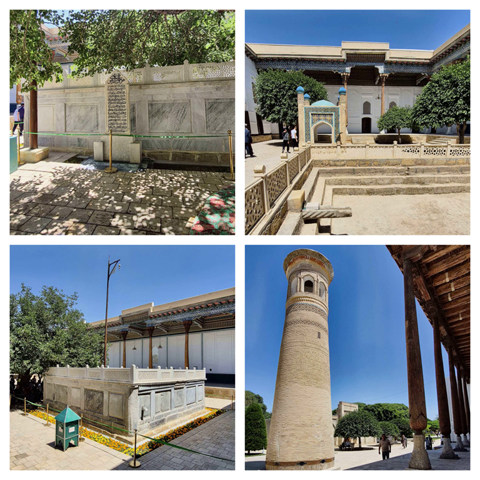
Bolo Haouz Mosque: The “Mosque of the Governor’s Pool”
Directly across from the Ark, you’ll find the stunning Bolo Haouz Mosque, built in 1712. It served as the Emir’s official place of worship and was one of the few mosques allowed to remain open during the Soviet era.
Its most striking features:
Wooden Columns: Twenty thin, tall, and beautifully carved wooden columns support the mosque’s iwan (entrance hall), giving it an elegant forest-like feel.
Ceiling Decorations: The painted wooden ceiling is an explosion of color and geometry.
Reflective Pool (Haouz): In front of the mosque is a serene water pool that reflects the columns and dome — an Instagram favorite!

Chashma-Ayub Mausoleum: “The Spring of Job”
Near the Ismail Samani Mausoleum, this unique shrine stands out with its conical dome — a rare architectural form in Central Asia.
Legend claims that the biblical prophet Job (Ayub) struck the ground here with his staff, miraculously creating a spring. The well inside still flows with water believed to have healing properties.
Pro tip: Don’t forget to sample the cool, mineral-rich water — locals consider it sacred.

Ismail Samani Mausoleum: An Architectural Masterpiece
This 10th-century mausoleum is considered one of the most important structures in Central Asian Islamic architecture.
Built as the final resting place of Ismail Samani, founder of the powerful Samanid dynasty, the mausoleum is famous for its intricate brickwork and perfectly symmetrical cube-like design. Remarkably well-preserved, it has withstood both time and earthquakes thanks to its pioneering construction technique — alternating layers of bricks placed at slightly different angles.
The structure remains a symbol of harmony and mathematical precision. No matter the lighting or time of day, it casts mesmerizing patterns of light and shadow.

Chor Bakr Necropolis: A Hidden Gem Beyond the City Walls
Located about 6 km southwest of Bukhara, Chor Bakr is a massive necropolis that dates back to the 16th century. It’s often called the “City of the Dead,” but the site exudes a peaceful serenity rather than gloom.
The name means “Four Brothers,” referring to four descendants of the Prophet Muhammad believed to be buried here. The site includes:
Mausoleums
Madrassas
Mosques
A large courtyard shaded by ancient trees
Why visit? It’s much less crowded than other tourist spots and provides a tranquil space for reflection and photography.

Sitorai Mohi Hosa: The Emir’s Summer Palace
A short drive from the city takes you to the Summer Palace of the last Emir of Bukhara. Built in the late 19th century, the palace is a fascinating mix of European and Central Asian architectural styles.
Notable highlights:
The White Hall: Lavish décor with gilded mirrors and floral motifs.
The Harem Courtyard: A glimpse into royal private life.
Art Galleries: Displaying Uzbek carpets, traditional costumes, and porcelain from China and Russia.
Walking the palace grounds feels like stepping into a dreamworld frozen in time.

Lyab-i Hauz Complex: The Heart of the Old City
This lively square surrounding a reflective pool (hauz) is the social and cultural heart of Bukhara. The area features:
Nodir Devonbegi Madrasa
Kukeldash Madrasa
Khanaka (Sufi lodge)
Nasreddin Hodja Statue: The beloved trickster-philosopher sits on a donkey, always drawing smiles from children and adults alike.

By day, it’s bustling with street vendors and musicians. By night, the area comes alive with lights, music, and laughter. Cafés and restaurants serve everything from shashlik (grilled kebabs) to manty (steamed dumplings).

Local Markets and Bazaars: A Sensory Adventure
No visit to Bukhara is complete without wandering through its historical trade domes:
Toki Zargaron (Jewellers’ Dome)
Toki Telpakfurushon (Hatmakers’ Dome)
Toki Sarrafon (Money Changers’ Dome)

Here you’ll find carpets, knifes, ceramics, silk scarves, hand-painted miniatures, spices, and more. Don’t be shy to haggle — it’s part of the fun!

Magok-i Attari Mosque
An interesting structure reflecting Bukhara's religious tolerance. Beneath the current mosque building are remains of a synagogue and even older Zoroastrian temple remnants dating back to the 9th and 12th centuries. Exploring the layers beneath the ground offers a fascinating experience.
Location: Very close to Lyabi Hauz.

Ulugh Beg and Abdulaziz Khan Madrasahs
The Ulugh Beg Madrasah and Abdulaziz Khan Madrasah, facing the same square, are not just educational institutions but also represent the cultural evolution of Bukhara.
Ulugh Beg Madrasah (1417): The Simple Face of Science
Built in 1417 by the Timurid ruler Ulugh Beg, this madrasah, along with the madrasahs in Samarkand and Gijduvan, is a symbol of his scientific legacy. The structure follows the classical Central Asian madrasah plan with two-story cells arranged around a square courtyard, classrooms, and a small mosque. Its portal is simple yet elegant, adorned with Kufic script, star motifs, and geometric patterns. The Hadith inscribed on it: "Seeking knowledge is obligatory for every Muslim man and woman." Architect: Ismail ibn Takhir ibn Mahmud Ispfargoni. Architectural Character: Symmetry, proportion, and restrained ornamentation.

Abdulaziz Khan Madrasah (1652): The Pinnacle of Grandeur and Aesthetics
Rising directly opposite the Ulugh Beg Madrasah, this magnificent structure was built in 1652 by the Bukhara Khan Abdulaziz Khan. Representing the peak of art and architecture, this building is much more ornate compared to the Ulugh Beg Madrasah. Its portal is imposing and striking, drawing attention with its muqarnas and multi-faceted facade. The interior features rich figurative decorations such as Chinese dragons, Simurgh (Phoenix) birds, and islimi (arabesque) patterns. Gold gilding, wall paintings, and embossed tiles transform the architecture into a work of art. However, some parts of the structure remain unfinished. The reason: resources were cut off after a political coup.

Two Worlds in One Square: Humility and Grandeur
These two madrasahs bring together the mentalities of different eras in the same frame. The Ulugh Beg Madrasah is an expression of knowledge and simplicity, while the Abdulaziz Khan Madrasah is an expression of power and art. Those visiting Bukhara should not leave without seeing these two structures side by side, because here, even the stone walls speak of history. Visiting Tip: In the morning, the light reveals the details of the Ulugh Beg Madrasah more clearly. In the evening, the tiles of the Abdulaziz Khan Madrasah shine like gold.
Chor Minor
Located slightly away from Bukhara's main historical center, about 500 meters east of the Lyabi Hauz complex, Chor Minor (Persian: "Four Minarets") is one of the city's striking structures.
History and Features of the Structure:
Chor Minor was built in 1807 by the wealthy Bukharan merchant Khalif Niyazkul. This structure is the main building of a larger complex founded by Niyazkul, which included a pond, guest rooms (similar to a caravanserai), and likely a winter mosque or a school (mekteb). Today, the most prominently surviving part of the complex is this central building known for its four minarets. The structure is a nearly square main building (likely used as an entrance gate or courtyard mosque) with a minaret topped with a turquoise dome at each of its four corners. The decorations on each minaret are different. According to some architectural interpretations, the shape of the domes on the structure may have been influenced by certain elements of Indian architecture. According to a popular legend, the four minarets represent the four main Sunni schools of law (Hanafi, Maliki, Shafi'i, Hanbali). However, experts state that this interpretation is related to the aesthetic design of the structure. The structure was used as a warehouse for a while during the Soviet era and was restored in the 1990s.
Visiting Information:
Location: East of Lyabi Hauz, near Fuzuli Street. It can be reached by walking from Lyabi Hauz in about 10 minutes.
Entrance: The courtyard of the structure is generally accessible. The interior of the main building may sometimes be closed. A small entrance fee is charged (around 0.5 USD).
Surroundings: Nearby are shops selling handicrafts and local tea houses. Although Chor Minor is smaller in scale compared to Bukhara's larger and more well-known monuments, it is an interesting place to visit in the city with its unique architecture and history.

Bukhara Central Bazaar
Located slightly outside Bukhara's historical center, the Central Bazaar is where the city's daily rhythm beats. This is a large market primarily used by the local population, where fresh produce and essential goods are sold. It may also be referred to by its Soviet-era name "Kolhoz Bazaar"; its official name is usually "Buxoro Markaziy Bozori".
The Central Bazaar is located just north or northeast of the historical city center. While it may not be within walking distance of most historical sites, it can be easily reached by a short taxi ride or local transport.

Goods Sold
Unlike the historical Toki bazaars which focus on handicrafts and tourist items, the Central Bazaar is primarily centered around food products. Here you can find:
Fresh Produce: All kinds of seasonal fruits and vegetables.
Dried Fruits and Spices: The region's famous dried fruits (apricots, plums, etc.), nuts such as pistachios, almonds, walnuts, and regional spices cover vast stalls.
Bread (Non): Various types of "non," the traditional Uzbek bread with different shapes and flavors, are abundant here.
Dairy Products: Dairy products such as yogurt, cheese, and local "kaymak" (clotted cream).
Meat and Other Foods: Meat products, grains, and other essential food items are also found in the bazaar.
Other Products: Besides food, it is possible to find everyday items such as clothing, shoes, and household goods, but the main focus of the bazaar is food.

The Central Bazaar has a very lively, noisy, and authentic atmosphere. The calls of the vendors, the smells of fresh produce, and the bustling shopping of the local people make it vibrant. It is less polished than the tourist areas and offers a window into real Bukhara life. These large, organized food markets are not as old as the smaller Toki bazaars, which were dedicated to specific crafts in the early Silk Road period. They emerged with the growth of cities and the modernization of food supply.
Today, they are the primary point where farmers and local vendors offer their products directly to the public. Visiting the Central Bazaar is a great experience for those who want to see not only Bukhara's historical structures but also its vibrant local culture. It is an ideal place to taste local flavors, take photos, and interact (at a simple level) with the local people. Bargaining is customary when shopping.
Chashma-i Ayub
Located in Bukhara's historical center, Chashma-i Ayub is an important structure whose name means "Spring of Job." According to legend, the prophet Job struck the ground with his staff here, and a spring of healing water gushed forth. This structure was built as a monument or mausoleum over that sacred spring. The current building took shape with additions made during different periods from the 14th to the 16th centuries, and it stands out with its unique conical dome, which is rarely seen in Central Asia.
Located near the Samani Mausoleum, Chashma-i Ayub houses a small museum today but still remains a site of historical and spiritual value. It is a peaceful spot symbolizing the faith and vitality of water in Bukhara's past.

Bukhara is a city that stands out with its historical structures, architecture, and cultural fabric. With its many places to visit and its atmosphere, it offers visitors a rich experience. If you are planning a trip to Central Asia, do not forget to add Bukhara to your list.


Yorumlar